Style Guide

How to Build a Capsule Wardrobe That Still Feels Personal

Build a capsule wardrobe that reduces clutter, keeps personality intact, and still gives you enough variety to get dressed with ease.

Article summary

  • Treat a capsule wardrobe as a working tool, not a rigid minimalist rulebook.
  • Start with your actual week, climate, and dress codes before deciding what belongs in the core.
  • Use a neutral base for cohesion, then add a small number of personality pieces with real outfit range.
  • Build around repeat wear, outfit combinations, and seasonal edits instead of arbitrary item counts.

Minimal wardrobe edit with tailored neutrals and a few expressive accents

What a capsule wardrobe is really for

A capsule wardrobe is a limited group of pieces that work together well enough to make daily dressing easier. That definition matters because people often confuse capsules with punishment. They picture bland beige basics, identical outfits, and a long list of things they are no longer allowed to enjoy. In practice, a good capsule should reduce friction, not identity.

The reason the idea has stayed useful for so long is simple. Most people do not struggle because they own too little. They struggle because too many pieces operate alone. A jacket works with one trouser but not the others. A statement top has no obvious layer. A good shoe only suits one kind of outfit. A capsule solves that by making interaction the point.

HiLo's version of a capsule wardrobe is not about chasing a certain aesthetic or proving restraint. It is about making sure the closet can reliably produce outfits that feel cohesive, wearable, and expressive. When every item has multiple partners and a clear role, you stop shopping to rescue weak outfits and start buying with more intention.

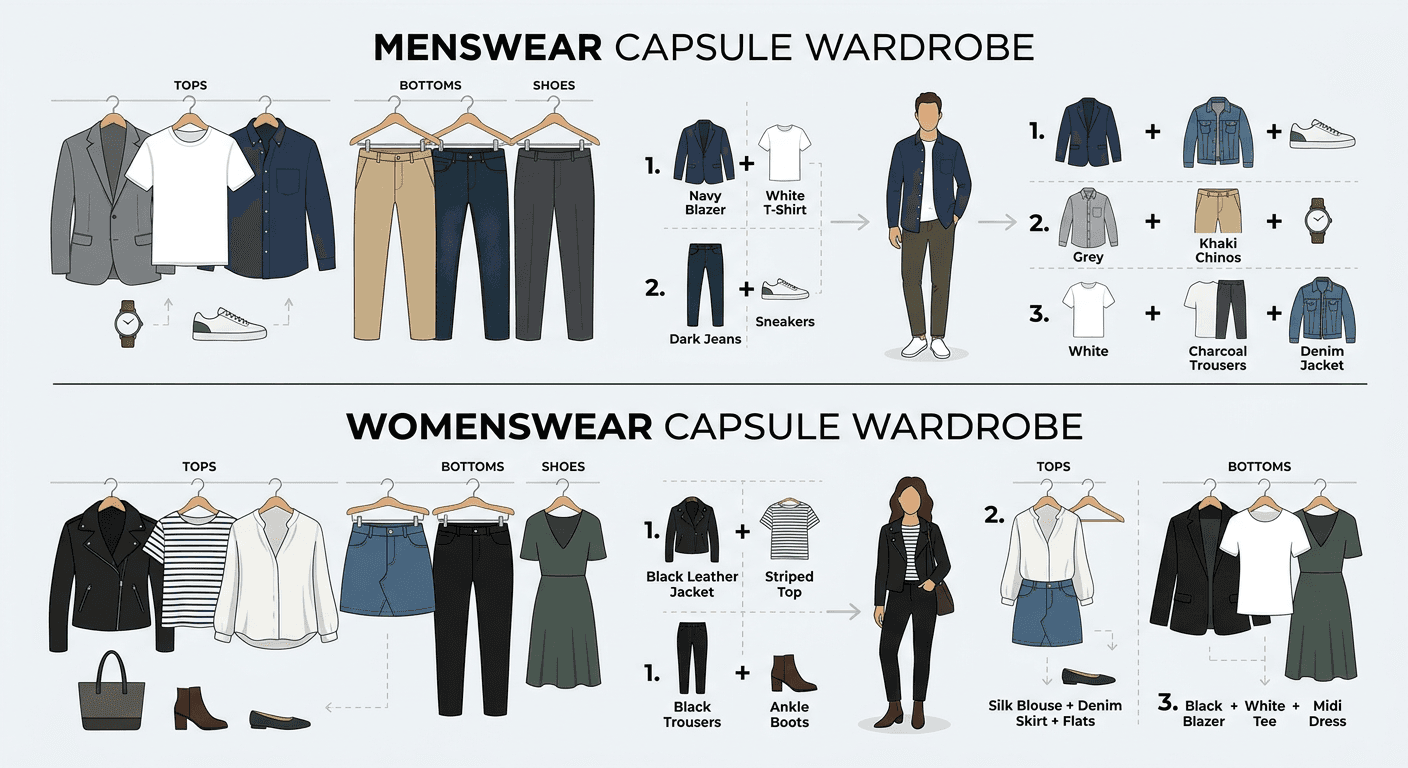
Capsule wardrobe grid with neutral staples and a few expressive pieces

Capsule wardrobe grid showing neutral staples and a few expressive pieces arranged by category

Photo by www.kaboompics.com on Pexels

Build around your real life, not an abstract ideal

The fastest way to build a bad capsule is to copy someone else's list. A capsule only works if it reflects your climate, schedule, commute, laundry habits, and comfort level. Someone who works in an office three days a week and walks everywhere needs a different core from someone who works remotely in a warm climate and dresses casually most of the time.

Start by looking at the outfits you actually repeat. Which categories pull the most weight. Which pieces fail because they are impractical, uncomfortable, or too isolated. This is more useful than trying to decide whether a capsule is supposed to contain twenty items or thirty. The right number is the number that covers your week without forcing constant compromise.

Edited wardrobe rack divided into work, weekend, and occasion pieces

Styled clothing rack edited into work, weekend, and occasion sections

Photo by MART PRODUCTION on Pexels

Identify the roles your wardrobe needs to cover

Divide your week into real wardrobe functions such as work, weekend, evening, travel, or weather protection. If your job is casual but polished, you may need more elevated trousers and overshirts than formal blazers. If you travel often, wrinkle resistance and layering matter more than delicate statement pieces. A capsule becomes useful when categories reflect life, not fantasy.

A simple rule helps here. Every category in the capsule should answer a recurring demand. If you rarely attend events, occasionwear should not consume the same space as everyday clothing. If you wear knitwear constantly, it deserves more room than trend tops you only reach for once a month.

Choose a palette that keeps the wardrobe connected

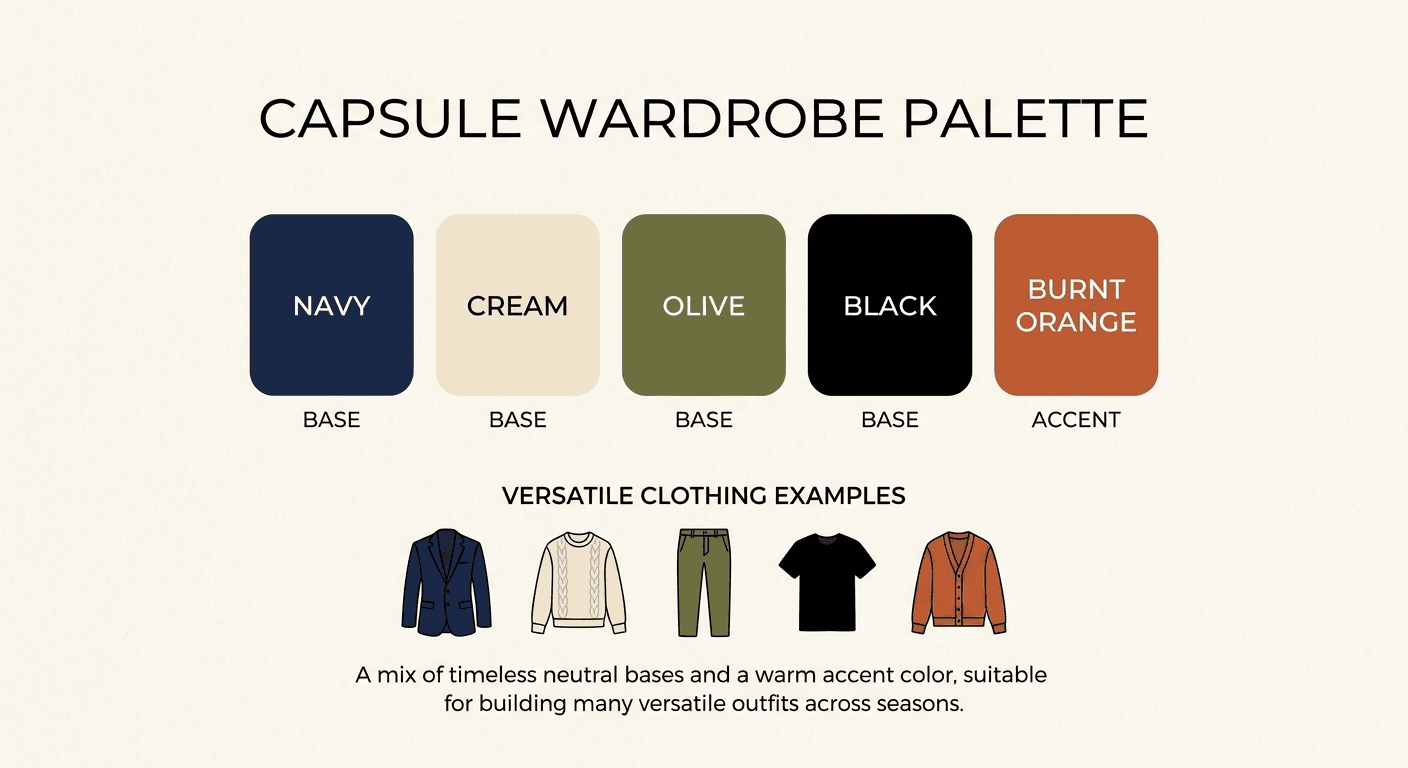
A capsule does not require an all-neutral closet, but it does require some discipline. Start with a stable foundation of two or three neutrals such as navy, cream, black, olive, camel, or charcoal. Those shades do the heavy lifting because they make shoes, layers, and bottoms easier to mix.

Then choose one or two accent directions that feel like you. That might mean washed red, forest green, butter yellow, cobalt, silver, or stripe. The question is not whether the accent is interesting. The question is whether it can plug into the neutral base without demanding its own separate wardrobe.

Capsule wardrobe color palette with neutrals and one accent color

Capsule wardrobe palette graphic mixing navy, cream, olive, black, and one accent color

Start with staples that earn repeat wear

Capsules succeed on dependable categories. A few shirts, tees, trousers, knit layers, outer layers, and shoes that can move between different contexts are more valuable than a closet full of one-note buys. This is where quality matters. A white shirt that holds its shape, a trouser that works with sneakers and loafers, and a jacket that can dress up denim all increase outfit count without increasing clutter.

Think in terms of usefulness instead of status. A staple belongs because it makes at least three other items more wearable. If it only works in one exact combination, it is probably not a staple yet.

Flat lay of capsule wardrobe foundations including shirts, trousers, knitwear, and shoes

Flat lay of capsule wardrobe foundations including shirt, tee, trousers, knitwear, loafers, and jacket

Photo by Rafael Oliveira on Pexels

Curated Product Recommendations

Staples

Province of Canada

Washed Poplin Shirt Navy - Unisex

Shirts

Washed Poplin Shirt Navy - Unisex
Elevated

COS

Men’s Cotton Straight-Leg Chinos

Trousers

Men’s Cotton Straight-Leg Chinos
Elevated

Meermin

Black Calf Horsebit Loafer

Footwear

Black Calf Horsebit Loafer

Add personality on purpose

This is the part people skip when they end up with a capsule that feels sterile. Personality pieces are what stop the wardrobe from becoming generic. They might be a striped rugby, a sculptural knit, a leather jacket, a bright bag, or a directional blouse. The goal is not to remove them. The goal is to choose them with the same intention as the basics.

Keep the number small and the function clear. Two or three personality pieces that work with the foundation usually go further than ten isolated statement buys. When a personality piece still works with your core trousers, shoes, or jackets, it adds energy without disrupting cohesion.

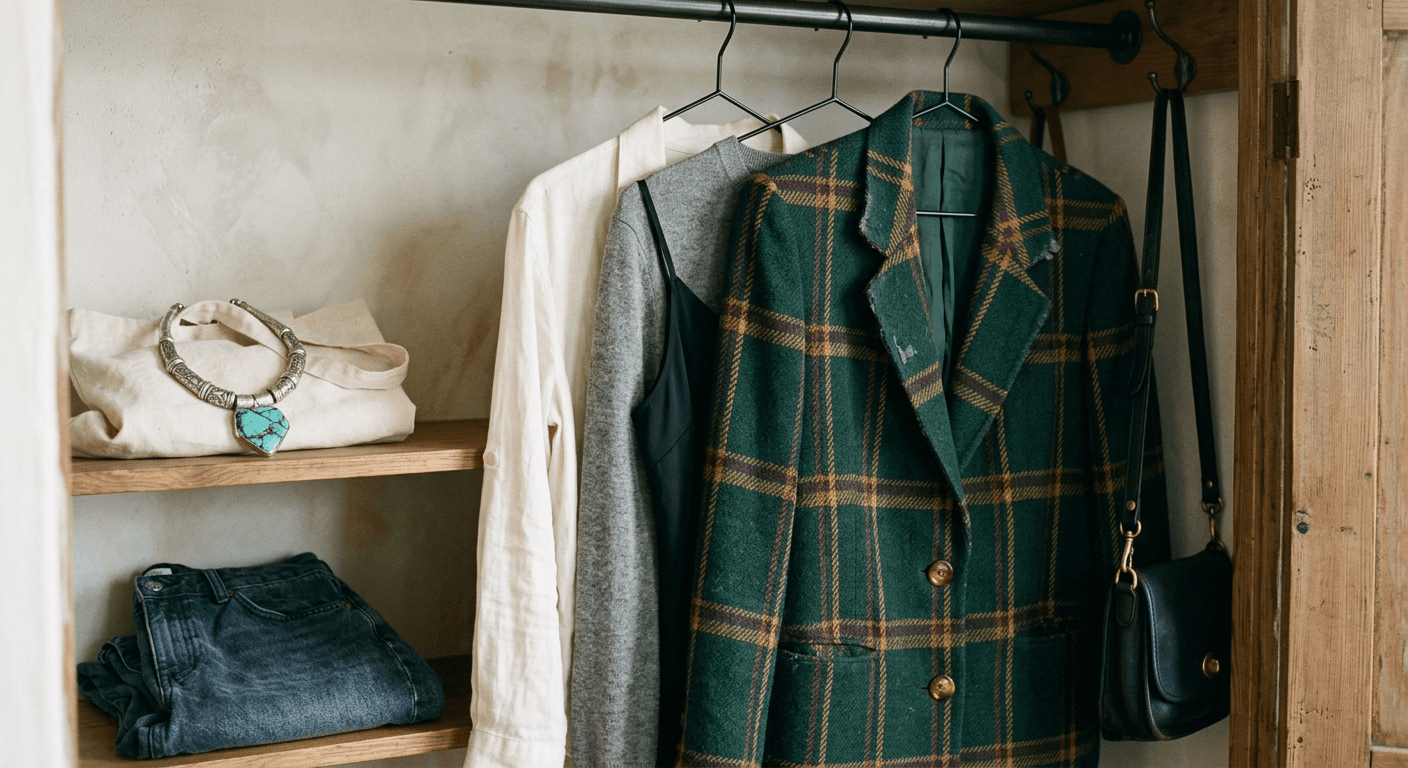
Capsule wardrobe base styled with one statement jacket and one expressive accessory

Editorial close-up showing a capsule wardrobe base with one statement jacket and one expressive accessory

Curated Product Recommendations

Elevated

Alltrueist

WANDA | Egyptian Cotton Pointelle knit Polo Shirt

Shirts

WANDA | Egyptian Cotton Pointelle knit Polo Shirt
Staples

Province of Canada

Charlie Rugby Shirt - Unisex

Shirts

Charlie Rugby Shirt - Unisex
Elevated

Eliza Faulkner

Laurence Jacket Shiraz

Outerwear

Laurence Jacket Shiraz
Elevated

Pauline Dujancourt

Red 'Unconditional Love' Crochet Heart Bag

Accessories

Red 'Unconditional Love' Crochet Heart Bag

Make the capsule visual and testable

A capsule is easier to build when you can see it. That is why a wardrobe grid or outfit matrix is so useful. Put tops down one side, bottoms across the top, then test the obvious combinations. You do not need every top to work with every bottom, but you do need enough overlap to avoid constant dead ends.

This exercise reveals where the real gaps are. Often the missing piece is not a whole new style direction. It is one trouser that bridges work and weekend, one shoe that softens tailoring, or one light layer that stops shirts from feeling stranded. A capsule should expose these gaps clearly so shopping becomes targeted instead of reactive.

Wardrobe matrix board showing outfit combinations from a capsule wardrobe

Wardrobe matrix board showing tops and bottoms combined into repeatable outfits

A 20-piece capsule works when your routine is narrow

If your wardrobe needs are fairly focused, twenty pieces can be enough. A useful formula might include five tops, four bottoms, three layers, two dresses or one-piece options, three shoes, and three accessories. The point is not precision. The point is keeping the system lean enough that every item keeps moving.

A smaller capsule works best when most of your week lives in one style lane. That might mean casual offices, a warm climate, or a strong preference for one silhouette family. If your life has fewer dress code swings, you can afford a tighter edit.

A 30-piece capsule gives more range without becoming cluttered

A thirty-piece capsule makes sense when you need more context shifts. Add another jacket, a couple more tops, one more bottom, and a second or third shoe mood. This usually works better for people balancing office days, weekends, travel, and occasional events, or for climates with more dramatic seasonal movement.

More pieces are not automatically a failure of discipline. They are a recognition that range matters. The question is whether the added pieces widen the outfit possibilities in a meaningful way. If they do, the capsule is still doing its job.

Maintain the capsule instead of freezing it in time

A capsule wardrobe should be edited, not locked. Style changes, work changes, body changes, and climate changes all affect what your closet needs. The best way to maintain a capsule is to review it seasonally and ask a few direct questions. What got worn most. What became annoying. What required too much styling effort. What no longer reflects you.

This is also where intentional shopping matters. Replace genuine weak links before adding novelty. Upgrade the tee that twists after washing. Replace the trouser that never quite fits. Then, if the foundation is solid, add one new personality piece that expands the outfit vocabulary rather than distracting from it. Capsules stay interesting when they evolve with clarity.

Common Mistakes

Building from a fantasy life

A capsule fails quickly when it is based on an imagined version of your week instead of the one you actually live. Start with your real dress codes, commute, and habits.

Treating personality as a problem

Removing every statement piece usually leads to boredom and rebound shopping. The better move is to keep a few expressive pieces that still work with the foundation.

Buying duplicates instead of solving gaps

Three nearly identical shirts do not create versatility if the wardrobe is missing a trouser, jacket, or shoe that helps everything connect.

Being too rigid about the item count

A capsule is a tool, not a contest. If twenty pieces are too few for your life, forcing the number will only make the wardrobe less useful.

Practical Examples

20-piece capsule for a mostly casual week

Five tops, four bottoms, three layers, two one-piece options, three shoes, and three accessories can work well when your week lives in one style lane and your climate is steady.

30-piece capsule for mixed work and weekend needs

Add a second blazer or jacket, two extra tops, one extra bottom, and another shoe mood to increase range without breaking cohesion.

Personality without clutter

Keep a neutral base of shirts, knitwear, jeans or trousers, and shoes, then add one statement jacket, one expressive knit, and one accessory with color or texture.

Using a wardrobe matrix before shopping

Lay out tops against bottoms and note which combinations already work. The missing links usually reveal better purchases than scrolling for inspiration does.

Product Call-Out Ideas

Capsule foundations worth starting with

  • crisp poplin shirt
  • everyday tee
  • straight-leg trouser
  • versatile loafer
  • light outer layer
  • fine-gauge knit

Personality pieces that still play well with basics

  • striped rugby
  • sculptural knit
  • colored jacket
  • statement bag
  • printed blouse
  • bold shoe

Useful capsule accessories

  • leather belt
  • lightweight scarf
  • simple jewelry
  • structured tote

HiLo Takeaway

A capsule wardrobe should make life easier, but it should still feel like your wardrobe. The goal is fewer dead ends, more outfit mileage, and a clearer sense of what deserves to stay.

Start with your real routine, choose a base that connects, and let a few personality pieces do meaningful work. That is how a capsule becomes cohesive instead of bland.

FAQ

Can a capsule wardrobe still include statement pieces?

Yes. A capsule works better when it includes a small number of personality pieces that still connect to the core. The problem is not statement pieces. It is isolated statement pieces.

How many items should a capsule wardrobe have?

There is no universal number. Twenty pieces can work for a narrow routine, while thirty may make more sense if your week includes work, weekends, travel, and events.

Do I need to throw out most of my closet to start a capsule?

No. Start by identifying what you already wear often, what mixes well, and what feels disconnected. A capsule can be built by editing and reorganizing before buying anything new.

What colors work best in a capsule wardrobe?

Two or three reliable neutrals plus one or two accent directions is usually enough. The best palette is one that lets most pieces work with at least three others.

What if my style changes after I build one?

That is normal. A capsule should be reviewed seasonally and updated as your life, climate, or taste changes. It is supposed to evolve.

Related Guides

Keep reading

View all guides

How to Build a Spring Wardrobe

Build a spring wardrobe with lighter layers, smart fabrics, and repeatable outfit formulas that handle weather swings without making your closet feel random.